
- Rated current
- 16 amperes
- 230V single-phase
- 3.68kVA nominal
- 400V three-phase
- About 11.09kVA nominal
- Typical starting point
- Lower-current final or equipment circuits after design review
Miniature circuit breaker selection guide
16A vs 32A MCB: What Actually Changes?
A 32A miniature circuit breaker carries twice the rated current of a 16A MCB, but it is not a safe automatic upgrade. The conductor, load, trip curve, breaking capacity, voltage, poles and installation conditions must still match.
Fast answer: at 230V single-phase, 16A equals 3.68kVA and 32A equals 7.36kVA. Those are comparison values, not permission to increase a breaker size. Never replace a 16A breaker with a 32A breaker until the complete circuit has been reviewed.
Rated current16A versus 32A continuous rating under stated conditions
Trip behaviorB16 and C16 share 16A but do not respond alike
Fault duty6kA or 10kA is separate from the ampere rating
Background photo by Santeri Viinamäki, licensed under CC BY-SA 4.0. Image shown without modification.
The direct comparison
The current rating doubles, but the selection process does not disappear
The number on the front tells you the rated current, In. It does not tell you the permitted conductor, acceptable voltage drop, magnetic trip behavior, short-circuit duty or whether the breaker is approved for the intended AC or DC circuit.
- Rated current
- 32 amperes
- 230V single-phase
- 7.36kVA nominal
- 400V three-phase
- About 22.17kVA nominal
- Typical starting point
- Higher-current final or equipment circuits after design review
Six decisions before the model code
Select from the complete electrical path
Define the load
Use operating current, starting current, power factor, duty cycle and any expected future load. Do not size from appliance output power alone.
Protect the conductor
Confirm conductor material, cross-section, installation method, ambient temperature, grouping, length and termination limits.
Choose the trip curve
Match the instantaneous region to inrush and fault-clearing needs. A B16, C16 and D16 do not behave the same during a current surge.
Check fault current
The rated breaking capacity must be adequate at the actual system voltage and installation point.
Confirm poles and voltage
Review phase conductors, neutral treatment, earthing and the exact AC or DC voltage rating for the model.
Verify evidence
Check the applicable standard, approved model scope, label, data sheet, test evidence and target-market requirements.
Interactive comparison tool
16A and 32A MCB Power Calculator
Compare nominal apparent power and estimated real power for DC, single-phase AC or balanced three-phase AC.
Calculated comparison
Nominal apparent power3.68 kVA
Estimated real power3.68 kW
Selected rating16A MCB
At 230V single-phase and PF 1.00, 16A corresponds to 3.68kVA and about 3.68kW. Final circuit selection still requires conductor and protection review.
Read more than the ampere number
The front label is a selection map
Two breakers can both say 16A and still be unsuitable substitutes. Read the complete marking and check it against the current manufacturer documentation.
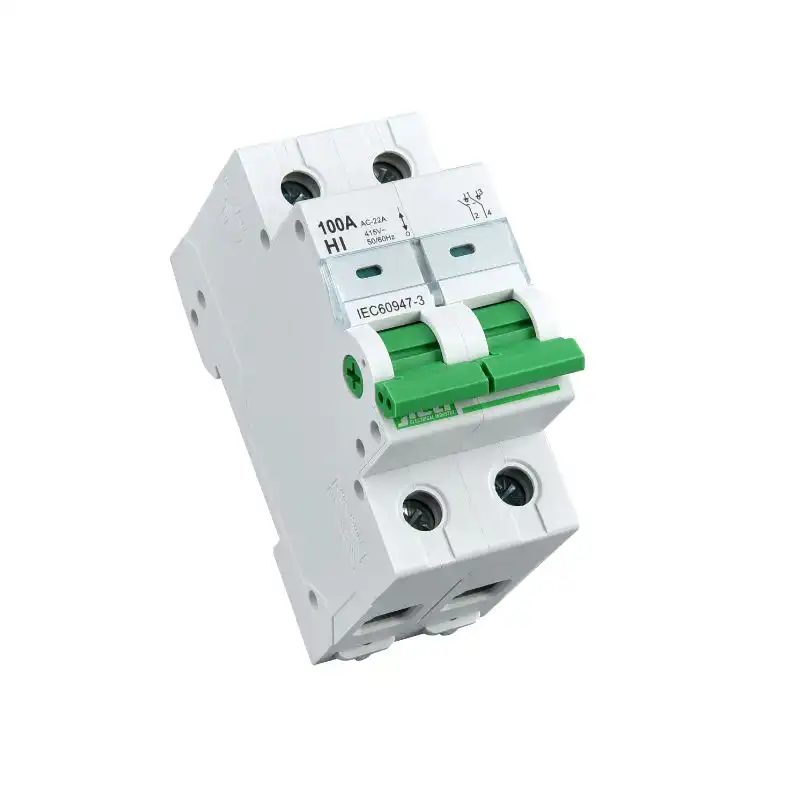
Curve and current
A code such as C16 combines the instantaneous trip curve with the 16A rated current.
Rated voltage and poles
Confirm AC or DC voltage, number of protected poles and any polarity or series-connection requirement.
Breaking capacity
A marking such as 6000 identifies a short-circuit performance value, not the normal load current.
Standard and model family
IEC 60898-1 and IEC 60947-2 cover different application contexts and performance declarations. Verify the exact standard shown.
Manufacturer documentation
Use the label with the current data sheet, temperature tables, dimensions, terminal data and certificate scope.
B, C and D are not quality grades
The curve letter changes the instantaneous trip region
A curve is chosen to allow normal starting current while still clearing faults correctly. It must be coordinated with loop or fault-current conditions, conductor protection and the exact device documentation.
B3–5 × In
Lower inrush direction
Often associated with resistive or low-inrush circuits where the model documentation and protection study support it.
C5–10 × In
Moderate inrush direction
Common in commercial and industrial circuits with a higher but controlled starting current.
D10–14 × In
High inrush direction
Used only where high starting current and available fault current support the selected model and curve.
The example ranges above follow Schneider Electric's Acti9 explanation. Curve boundaries and application details must be checked for the exact manufacturer, standard and model. Source: Schneider Electric, “What does B, C, D curve mean for Acti9 MCB?”
Cable and fault duty
Two checks prevent the most common 16A-to-32A mistake
1. The conductor must remain protected
A breaker limits overcurrent for the circuit conductors. The conductor's allowable current is affected by more than its nominal cross-section.
- Conductor material, insulation and temperature rating
- Installation in conduit, trunking, tray, free air or insulation
- Ambient temperature and grouping with other loaded circuits
- Circuit length, voltage drop and termination limits
- Local wiring rules and equipment instructions
2. The breaker must interrupt the fault
Normal current and short-circuit current are different decisions. A 32A breaker with inadequate breaking capacity is not made safe by its higher current rating.
- Prospective short-circuit current at the installation point
- Rated voltage and the declared breaking value at that voltage
- Icn, Icu or Ics terminology under the applicable standard
- Upstream and downstream coordination or selectivity objective
- Backup protection permitted by manufacturer data, if used
Do not use a nuisance trip as proof that the breaker is too small. The cause may be overload, motor inrush, a short circuit, earth leakage, loose connections, heat, a damaged load or the wrong trip curve. Diagnose the circuit before changing the rating.
MCB, RCCB and RCBO functions
A higher MCB rating does not add residual-current protection
Overload and short-circuit protection, earth-leakage protection and isolation are separate functions. Confirm what the installed device actually provides.
| Device | Primary function | What the 16A or 32A marking means | Key additional check |
|---|---|---|---|
| MCB | Overload and short-circuit protection | Rated current under stated conditions | Curve, breaking capacity, conductor and fault level |
| RCCB / RCD | Residual-current detection and disconnection | Rated current is not an overcurrent trip setting | Sensitivity, type, upstream overcurrent protection and coordination |
| RCBO | Combined residual-current and overcurrent protection | Rated current belongs to the overcurrent function | Curve, residual-current type and sensitivity, breaking capacity and poles |
Can 16A be replaced by 32A?
Only after the circuit is redesigned or verified for 32A
A safe review covers the source, conductor, terminations, load, voltage drop, trip curve, short-circuit duty, poles, enclosure, ambient conditions and applicable rules. Matching the rail width is not enough.
Send these details for an RFQ
Electrical systemAC or DC, voltage, frequency, phase system, poles and earthing arrangement.
Load informationOperating current, power, starting current, load type and duty cycle.
Conductor and installationMaterial, size, length, installation method, grouping and ambient temperature.
Protection dataRequired curve, prospective fault current, breaking capacity and coordination objective.
Market and quantityDestination, required standards, approvals, sample quantity and annual demand.
Continue the selection
Use the next page for the next engineering question
Frequently asked questions
16A and 32A MCB questions, answered clearly
What is the main difference between a 16A and 32A MCB?
The main numerical difference is rated current: 32A is twice 16A. The actual model choice also depends on voltage, poles, trip curve, breaking capacity, conductor protection, fault current, installation conditions and the applicable standard.
Can I replace a 16A MCB with a 32A MCB?
Not as a simple swap. A 32A breaker may fail to protect conductors and terminals designed for a lower current. The complete circuit must be verified or redesigned for 32A before the change.
How many watts can 16A and 32A carry at 230V?
For single-phase arithmetic, 16A at 230V equals 3.68kVA and 32A equals 7.36kVA. Real power in kW depends on power factor, and these calculations do not approve the conductor or breaker selection.
Is a C32 breaker stronger than a B32 breaker?
Both have a 32A rated current. The curve letters describe different instantaneous trip regions; they are not quality grades. Select the curve from load inrush, fault current and protection requirements.
Does a 10kA MCB carry more load than a 6kA MCB?
No. The kA marking relates to short-circuit interruption under defined test and voltage conditions. The normal load current is identified separately by the ampere rating.
Does a 32A MCB protect against electric shock?
An MCB primarily protects against overload and short circuit. Residual-current protection requires an RCCB, RCD, RCBO or another approved arrangement selected for the installation.
Can the same MCB be used on AC and DC?
Only when the exact model documentation permits the intended AC or DC voltage, polarity, pole arrangement and breaking duty. Do not infer DC suitability from the AC rating.
Technical references
Send the circuit data, not only “16A or 32A”
Share the one-line diagram, voltage, poles, load, conductor, fault level, curve, quantity and destination. SENTOP can help organize the model review and quotation inputs.