Introduction
When a breaker (often called an MCB in IEC contexts) “trips,” it has shut itself off to prevent damage or fire. If your MCB keeps tripping, treat it as a safety signal—not an inconvenience. Start by turning off or unplugging devices on that circuit, and don’t keep flipping the breaker back on repeatedly. A proper reset means pushing the handle fully to OFF before switching back to ON.
Quick triage helps: note whether the trip happens instantly or after a few minutes under use; list what was running (space heater, hair dryer, microwave, window AC); and check for any smell of burning, unusual heat, or buzzing. In U.S. homes, you’re working with 120/240 V split-phase service and typical 15 A and 20 A branch circuits. Bedrooms and living areas often use AFCI protection, while wet or outdoor locations use GFCI.
How to use this guide: isolate loads, perform one safe reset, and then add devices back one by one to find the trigger. If the breaker trips again immediately with everything unplugged or you notice heat, odor, or damage, stop and call a licensed electrician.
Key takeaways
- If your MCB keeps tripping instantly, suspect a short circuit or ground fault; stop resetting and call a pro.
- If it trips after minutes of use, reduce high‑wattage devices and spread loads—overload is likely.
- Use one safe reset only: switch fully OFF, then ON. Do not keep retrying.
- AFCI protects against arc faults in living/sleeping areas; GFCI protects people in wet/outdoor areas.
- Never upsize a breaker to stop trips; balance loads or add circuits instead.
Why your MCB keeps tripping
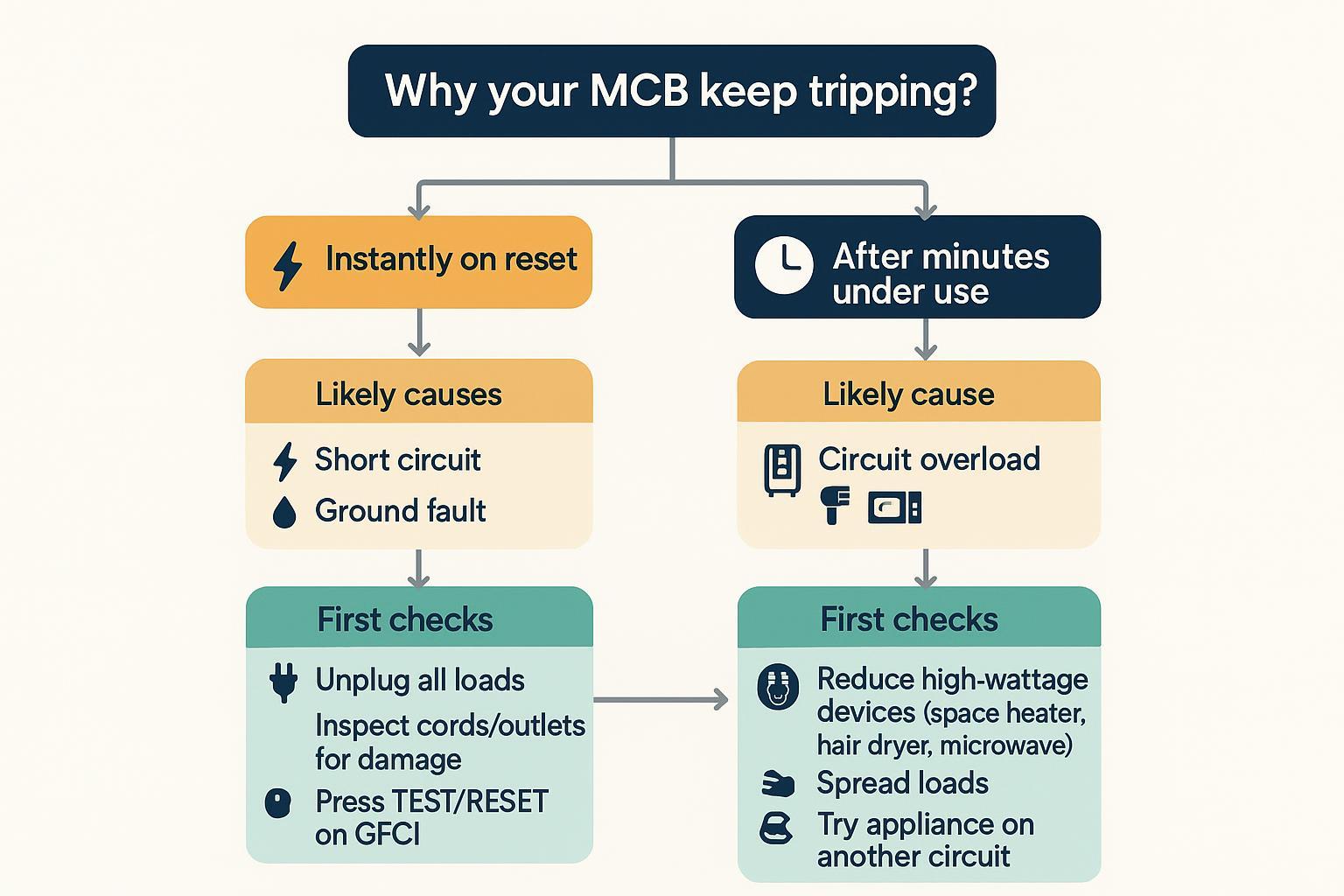
A breaker trips to protect wiring from overloads and to clear dangerous faults. In plain terms: a delayed trip under use suggests an overload (thermal response), while an instant “click” on reset points to a short circuit or ground fault (magnetic or GFCI response). Reset once correctly, then observe timing and symptoms.
According to utility and service guidance, the correct reset involves moving the handle fully to OFF, then back to ON; avoid repeated resets and stand to the side for safety. See the step-by-step reset guidance from the EPCOR utility and national service brands for clear homeowner instructions: EPCOR’s guide to resetting a breaker panel and Mr. Electric on what to do when a breaker trips.
Circuit overload
You’ll often see this after adding heat appliances on the same 15 A or 20 A circuit—space heater plus hair dryer, or microwave plus toaster. The breaker may hold for a few minutes and then trip as heat builds in the bimetal strip. Unplug or turn off high‑wattage devices, spread them across different circuits, or try the appliance on another properly rated circuit. If overloads are common in a room, ask a licensed electrician about adding a dedicated circuit. Never install a larger‑amp breaker on existing wiring.
Short circuit
A short circuit is a very low‑resistance fault that draws a surge of current. That magnetic surge trips the breaker instantly—often with a sharp click, maybe a spark or a mark at the device that failed. Unplug everything on the circuit and reset once correctly. If it trips immediately with no loads connected, stop and call a licensed electrician. Inspect visible cords and plugs for damage or scorch marks, but don’t open the panel or devices yourself.
Ground fault
A ground fault is unintentional current to ground, especially common in wet/outdoor areas. GFCI outlets or breakers detect a tiny imbalance and trip quickly to protect people from shock. In bathrooms, kitchens, garages, outdoors, basements, and laundry areas, press TEST then RESET on the GFCI outlet or breaker. If it won’t reset, dry the area and remove connected devices. Persistent trips or moisture intrusion are a stop sign—call a licensed electrician. For consumer-friendly context on where GFCI is required and how AFCI/GFCI apply in homes, see Home Depot’s overview of GFCI coverage and Eaton’s AFCI/GFCI requirements.
Symptom-to-cause quick matrix:
| Symptom | Likely cause | First homeowner steps | When to call a licensed electrician |
|---|---|---|---|
| Trips instantly on reset | Short circuit or ground fault | Unplug all loads; reset once; test GFCI where present | If it re-trips immediately with no loads; any burning smell/heat/buzzing |
| Trips after minutes of use | Overload (thermal) | Reduce high‑wattage devices; spread loads; try appliance elsewhere | If trips continue despite reduced load; warm or discolored outlets |
| Trips using one appliance | Faulty device or inrush | Try it on another circuit; check cord/plug | If multiple circuits trip; sparks or scorch marks |
| GFCI won’t reset | Persistent ground fault or failed device | Dry area; unplug devices; press TEST then RESET | If it won’t reset or trips repeatedly; moisture intrusion suspected |
More causes and fixes
Loose or damaged wiring/terminals
Intermittent trips, warm outlets, buzzing at a receptacle, or a panel cover that feels hot can point to loose connections. This is not a DIY fix—do not remove the panel deadfront or tighten lugs. Call a licensed electrician for inspection and repair.
Faulty or incorrect breaker
Old, damaged, or mismatched breakers can nuisance‑trip or fail to protect. Do not upsize the breaker to “solve” tripping—that creates a fire risk. Have a licensed electrician confirm the correct UL 489 branch‑circuit rating and replace the breaker if needed.
Prevention and the right breaker
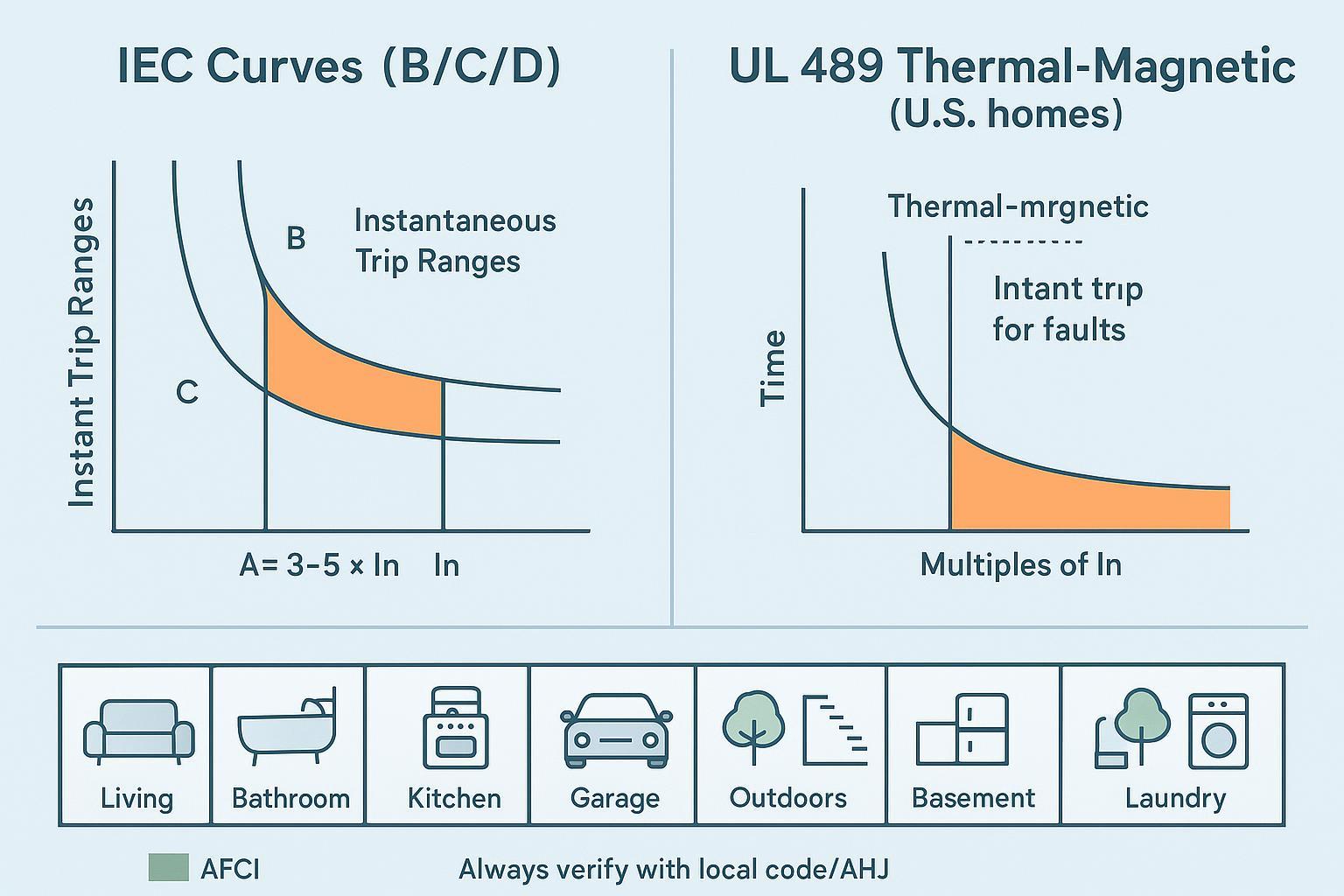
Choosing the right protection and spreading demand go a long way toward preventing future trips.
Balance loads and add circuits
Avoid stacking multiple heat appliances on one 15 A/20 A circuit. Space heaters, hair dryers, microwaves, and window ACs each can draw close to a circuit’s usable capacity. If a room regularly overloads, ask a licensed electrician to add a dedicated circuit or rebalance loads across your panel. Never replace a 15 A breaker with a 20 A breaker unless a licensed electrician has verified the wiring and devices are correctly rated.
Trip curves, AFCI/GFCI selection
In U.S. homes, branch‑circuit breakers are UL 489 thermal‑magnetic devices. The “curve” concept helps explain why some breakers tolerate motor inrush better than others, but residential panels typically don’t show IEC B/C/D letters. As a comparison, IEC type B trips instantly around 3–5× its rating, type C around 5–10×, and type D around 10–20×. UL 489 breakers also have thermal delay for modest overloads and an instantaneous magnetic trip for big faults. Where required, use AFCI protection in most living/sleeping areas and GFCI where water or outdoors are involved; when both are needed, dual‑function devices or combinations may be used—verify with your local authority having jurisdiction (AHJ) and manufacturer instructions. For a single background reference on certification and selection basics, Disclosure: Onesto is our product.
Maintenance and safe testing
Test GFCI outlets or breakers regularly using the TEST/RESET buttons. Many sources recommend monthly checks; some modern devices self‑test but still provide a manual test button. Test AFCI or dual‑function breakers per the manufacturer’s instructions (look for the TEST button). Persistent nuisance trips or trips without obvious cause warrant a licensed electrician’s evaluation, and periodic professional panel inspections are a smart preventive step—especially in older homes.
Conclusion
If your MCB keeps tripping, match the fix to the cause: delayed trips often mean overloads—reduce demand or add circuits; instant trips point to shorts or ground faults—stop resetting and call a licensed electrician. Use AFCI and GFCI protection where required, never upsize breakers to “solve” tripping, and keep up with simple tests and maintenance. When in doubt—or anytime the breaker re‑trips immediately, you smell burning, see scorch marks, or a GFCI won’t reset—bring in a licensed electrician to keep your home safe.
References
- EPCOR — “How to Reset a Breaker Panel” (utility homeowner guidance). See EPCOR: How to reset a breaker panel.
- Mr. Electric — “What to Do When Your Circuit Breaker Trips” (homeowner triage and escalation). See Mr. Electric: What to Do When Your Circuit Breaker Trips.
- Mister Sparky — “Is It Safe to Reset a Tripped Breaker?” (reset safety and red flags). See Mister Sparky: Is It Safe to Reset a Tripped Breaker?.
- Eaton — “What you need to know about AFCI and GFCI requirements” (manufacturer overview of AFCI/GFCI scope and installation guidance, NEC context). See Eaton: AFCI and GFCI requirements.
- The Home Depot — “GFCI Requirements & Legislation” (consumer-facing summary of where GFCI protection is required). See Home Depot: GFCI Requirements & Legislation.
- Schneider Electric — FAQ on B/C/D curves (IEC curve primer useful for comparison to UL behavior). See Schneider Electric: B/C/D trip-curve FAQ.
- RS Components — “An introduction to UL 489 current‑limiting MCBs and their trip curves” (background on UL thermal‑magnetic behavior). See RS Components: UL 489 trip curves primer.
- NAHB — “AFCI and GFCI requirements by state” (PDF summary of state-level adoption tied to NEC updates). See NAHB: AFCI and GFCI requirements (PDF).
- HUD / NSPIRE — “NSPIRE Standard: GFCI & AFCI outlet or breaker” (federal standard guidance summary). See HUD NSPIRE: Electrical GFCI/AFCI standard.
Internal SENTOP background links (for further reading on ratings and certification):
- SENTOP — Current ratings overview for home breakers: SENTOP: Current ratings of home circuit breakers.
- SENTOP — How to identify certified single‑phase MCCB (certification basics): SENTOP: How to identify certified single‑phase MCCB.
- SENTOP — Residual current circuit breaker (RCCB) overview: SENTOP: Residual current circuit breaker.