

You use fuses to keep your 12V systems safe, and understanding 12V fuse sizing is crucial. Many people think fuses protect devices, but they actually protect wires from overheating and potentially catching fire. If you choose the wrong fuse size, you can cause significant problems. The NFPA states that about 20% of electrical fires in low-voltage systems occur because people use electrical parts, like fuses, incorrectly.
| Cause of Electrical Fires | Percentage (%) |
|---|---|
| Improper Fuse Use | 20 |
You must match the fuse size to the device current and wire ampacity. Picking the right 12V fuse sizing ensures your system remains safe and operates efficiently.
Key Takeaways
- Fuses keep wires from getting too hot and starting fires. They do not just protect devices. Always think about wire safety first when picking a fuse.
- Pick a fuse that matches the device’s current and the wire’s ampacity. This helps everything work safely.
- Use the 125% rule for most devices to find the smallest fuse size. This helps with normal current surges.
- Always put the fuse within 7 inches of the power source. This lowers the chance of the wire getting too hot before the fuse works.
- Never use a fuse that is too big. A fuse that is too large might not blow when it should. This can cause wires to get too hot and start a fire.
- Look at the wire gauge and its ampacity before you pick a fuse. Make sure the wire can safely carry the current.
- Use a checklist for fuse sizing so you do not make mistakes. Every step is important for keeping the system safe.
- Taking time to pick the right fuse size saves money on repairs. It also makes your 12V system work better and last longer.
Fuse Protection Basics
Why Fuses Matter
You rely on fuses to keep your 12V electrical systems safe. Fuses act as a “sacrificial” part in your circuit. When too much current flows, the fuse melts and breaks the circuit. This stops the flow of electricity before it can damage your equipment or start a fire.
Fuses play several important roles in 12V systems:
- They protect against overcurrent conditions.
- They prevent electrical fires.
- They help isolate faulty sections of a circuit.
A fuse contains a thin metal wire or strip. If the current gets too high, this wire melts. The circuit opens, and the flow of electricity stops. This simple action can save your wires, devices, and even your vehicle or boat from serious harm. According to safety standards like IEC127, fuses ensure your system operates safely and meets important regulations.
Wire vs. Device Protection
Many people think fuses protect devices. In reality, you use fuses to protect wires first. The wire is often the weakest link in your circuit. If too much current flows, the wire can overheat and its insulation can melt. This can cause a fire.
The fuse’s primary job is to blow before the wire’s insulation melts. The device is secondary. In fact, most manufacturer-recommended fuse ratings are lower than what the device can technically handle—they’re sized to protect the wire you’re likely to use, not the maximum the device can survive.
When you choose a fuse, always check the wire’s ampacity first. If your device needs a higher fuse rating than your wire can handle, you must upgrade the wire. Never just use a bigger fuse. This is a key rule in 12V fuse sizing.
- Size the fuse based on the wire’s ampacity.
- Upgrade the wire if the device needs more current than the wire can safely carry.
Risks of Wrong Fuse Use
Using the wrong fuse size can lead to serious problems. If you use a fuse that is too large, it may not blow when it should. This can cause wires to overheat, melt, or even catch fire. If you use a fuse that is too small, it may blow too often and interrupt normal operation.
| Risk | Cause |
|---|---|
| Excessive current | Incorrect wiring (wrong connections due to human error) |
| Damage to the circuit | Circuit damage (e.g., loose wires or insulation wear causing shorts) |
| Overloading the circuit | Connecting equipment that draws more current than the circuit can handle or using undersized cables |
You must always match the fuse size to both the device current and the wire ampacity. This careful approach to 12V fuse sizing keeps your system safe and reliable.
12V Fuse Sizing Method

Choosing the right fuse for your 12V system means you must look at more than just the device you want to protect. You need to check both the current your device draws and the amount of current your wire can safely carry. This two-factor method helps you avoid common mistakes and keeps your system safe.
Two Key Factors
When you size a fuse for a 12V system, you must consider two main things:
- Current and voltage requirements for your device. For example, check your device’s maximum output current in its specs.
- Safety margin. Always pick a fuse rated 10-20% higher than your device’s maximum current. This gives you a buffer for normal surges.
You cannot ignore either factor. If you only look at the device, you might overload your wire. If you only look at the wire, you might not protect your device from short circuits. The best 12V fuse sizing method checks both.
Tip: Always use a fuse that protects the wire first. If your device needs more current than your wire can handle, upgrade the wire before increasing the fuse size.
Device Current Calculation
You need to know how much current your device uses. Most devices list their power in watts. You can use a simple formula to find the current:
| Formula | Description |
|---|---|
| I = P / E | Current calculated from power and voltage |
| I = E / R | Current calculated from voltage and resistance |
For most 12V systems, use the first formula. Divide the device’s power (watts) by the system voltage (12 volts) to get the current in amps. For example, a 60-watt device on a 12V system draws 5 amps (60 ÷ 12 = 5).
After you find the current, apply the 125% rule. Multiply the current by 1.25 to get the minimum fuse size. This extra 25% covers small surges and keeps your fuse from blowing during normal use.
Wire Ampacity Check
Now, check if your wire can handle the fuse size you picked. Each wire gauge has a maximum safe current, called ampacity. Use the table below to find the ampacity for common wire sizes in 12V systems:
| Wire Gauge (AWG) | Ampacity (A) |
|---|---|
| 10 | 30 |
| 12 | 20 |
| 14 | 15 |
| 16 | 10 |
Ampacity ratings come from the National Electrical Code. These numbers assume the wires are in a cool place (about 85°F) and not bundled with many others. If your wires run through hot spaces or are very long, you should use a lower ampacity for safety.
Note: Never use a fuse that allows more current than your wire’s ampacity. If you need a bigger fuse for your device, you must use a thicker wire.
To sum up, safe 12V fuse sizing means you:
- Calculate your device’s current draw.
- Apply the 125% rule to pick a fuse size.
- Check your wire’s ampacity to make sure it matches or exceeds the fuse.
- Choose the right fuse type and place it close to the power source.
By following these steps, you protect both your wires and your devices, and you keep your 12V system safe.
12V Fuse Sizing Steps
Step 1: Find Device Current
Before you pick a fuse, you need to know how much current your device uses. This step helps you avoid guessing and ensures your system works safely.
Amps = Watts ÷ Volts
You can find the current draw of your device using a simple formula:
Amps (A) = Watts (W) ÷ Volts (V)
For example, if your device uses 48 watts on a 12-volt system:
Amps = 48W ÷ 12V = 4A
If you do not know the wattage, check the device label or manual. You can also measure the current directly with a multimeter. Place the black probe in the COM port and the red probe in the 10A port for larger currents. A DC clamp meter can also help, especially for small currents, but make sure to zero it before measuring. Always measure the input voltage, not just the output, because voltage drops can affect the current draw.
Tip: Always include any extra devices, like alarms or small lights, in your total current calculation. This gives you a more accurate number for 12V fuse sizing.
Continuous vs. Surge Loads
Some devices, like motors or pumps, draw more current when they start up. This is called a surge load. Other devices, like lights, use the same current all the time (continuous load).
- For continuous loads, use the normal running current in your calculation.
- For surge loads, check the device manual for the maximum surge current. If you cannot find it, multiply the running current by 2 to estimate the surge.
Always plan for the worst-case scenario. If your device sometimes draws more current, size your fuse for that higher number. This keeps your system safe and prevents nuisance fuse blowing.
Step 2: Apply Sizing Rules
Now that you know your device’s current, you need to pick a fuse that can handle it safely. You do this by adding a safety margin and rounding up to the nearest standard fuse size.
125% Rule for Most Loads
For most devices, multiply the running current by 1.25 (or add 25%). This covers small surges and keeps your fuse from blowing during normal use.
| Step | Example (Device draws 8A) |
|---|---|
| Multiply by 1.25 | 8A × 1.25 = 10A |
| Choose fuse size | 10A fuse |
250% Rule for Motors
Motors and some pumps need a bigger safety margin because they draw much more current at startup. Multiply the running current by 2.5 (or 250%).
| Step | Example (Motor draws 6A) |
|---|---|
| Multiply by 2.5 | 6A × 2.5 = 15A |
| Choose fuse size | 15A fuse |
Round Up to Standard Size
Fuses come in standard sizes, like 5A, 7.5A, 10A, 15A, 20A, and 25A. Always round up to the next standard size. For example, if your calculation gives you 13A, use a 15A fuse.
Here is a quick guide:
- Determine max current (from Step 1).
- Add safety margin (multiply by 1.25 or 2.5).
- Round up to the nearest standard fuse size.
Note: Never pick a fuse smaller than your calculated value, or it may blow during normal use.
Step 3: Check Wire Ampacity
After you pick your fuse size, you must check if your wire can handle the current. This step is critical for safe 12V fuse sizing.
Use Ampacity Charts
Each wire gauge has a maximum safe current, called ampacity. Use an ampacity chart to match your wire size to your fuse.
| Wire Gauge (AWG) | Max Ampacity (A) |
|---|---|
| 16 | 10 |
| 14 | 15 |
| 12 | 20 |
| 10 | 30 |
If your fuse is rated for 15A, you need at least 14 AWG wire. If your wire is smaller than your fuse, you risk overheating and fire.
Consider Length & Temp
Long wires and hot environments reduce ampacity. If your wire runs a long distance or passes through hot areas, use a thicker wire. This prevents voltage drop and keeps your system safe.
- For every 10 feet of wire, check if you need to go up one wire size.
- If your wires run in a hot engine bay, use a wire with a higher ampacity rating.
Derating for Safety
Sometimes, you need to lower the ampacity rating for extra safety. This is called derating. For example, if your wire runs with many others in a bundle, or if it is exposed to high temperatures, reduce the ampacity by 20-30%.
Tip: Always make sure your fuse is rated lower than the smallest wire in the circuit. This protects your wiring and prevents damage.
By following these steps, you ensure your 12V fuse sizing protects both your devices and your wiring. You also make your system safer and easier to troubleshoot.
Step 4: Choose Fuse Type & Placement
Common Fuse Types
You need to pick the right fuse type for your 12V system. Each type works best for certain jobs. The table below shows the most common fuse types and what they do:
| Fuse Type | Description |
|---|---|
| Glass Tube Fuses | Used for small circuits with low power. These are common in older cars and simple electronics. |
| Midi Fuses | Good for medium to high loads. Many people use them for car audio or RV power systems. |
| Mega Fuses | Handle even higher currents. You find these in large vehicles or big battery banks. |
| ANL Fuses | Protect high current circuits in boats, cars, and off-grid setups. |
| Circuit Breakers | You can reset these after they trip. They work well if you expect to have over-current sometimes. |
| MRBF Terminal Fuses | Offer top protection by connecting right at the battery terminal. This keeps cables safe. |
| Class-T Fuses | Best for high-power systems, like those with lithium batteries. They stop very high short-circuit currents. |
You should match the fuse type to your system’s needs. For example, use a glass tube fuse for a small light, but pick a Mega or ANL fuse for a large inverter. If you want to reset the fuse instead of replacing it, choose a circuit breaker.
Tip: Always check your device manual or wiring diagram. It often tells you which fuse type works best.
7-Inch Placement Rule
You must place your fuse as close to the power source as possible. The 7-inch rule helps you remember this. Put the fuse within 7 inches of the battery or main power connection. This keeps the wire between the battery and fuse very short.
If a short circuit happens before the fuse, the wire can overheat and catch fire. By following the 7-inch rule, you protect the whole circuit from the very start.
- Measure from the battery terminal to the fuse holder.
- Keep this distance under 7 inches (about 18 centimeters).
- If you cannot do this, use a special terminal fuse like an MRBF.
Note: The shorter the wire before the fuse, the safer your system will be.
Proper Installation
You need to install your fuse correctly for it to work well. Follow these steps for safe and reliable results:
- Turn off all power before you start.
- Use a fuse holder that matches your fuse type and size.
- Make sure all connections are tight and clean. Loose wires can cause heat and failure.
- Place the fuse holder in a spot that is easy to reach. This helps you check or change the fuse later.
- Label the fuse with its rating and what it protects. This makes troubleshooting easier.
Always double-check your work. A good installation keeps your 12V fuse sizing safe and your system running smoothly.
By choosing the right fuse type, placing it close to the power source, and installing it properly, you finish the last step in safe 12V fuse sizing. This protects your wires, devices, and gives you peace of mind.
Fuse Sizing Mistakes
Oversized Fuses
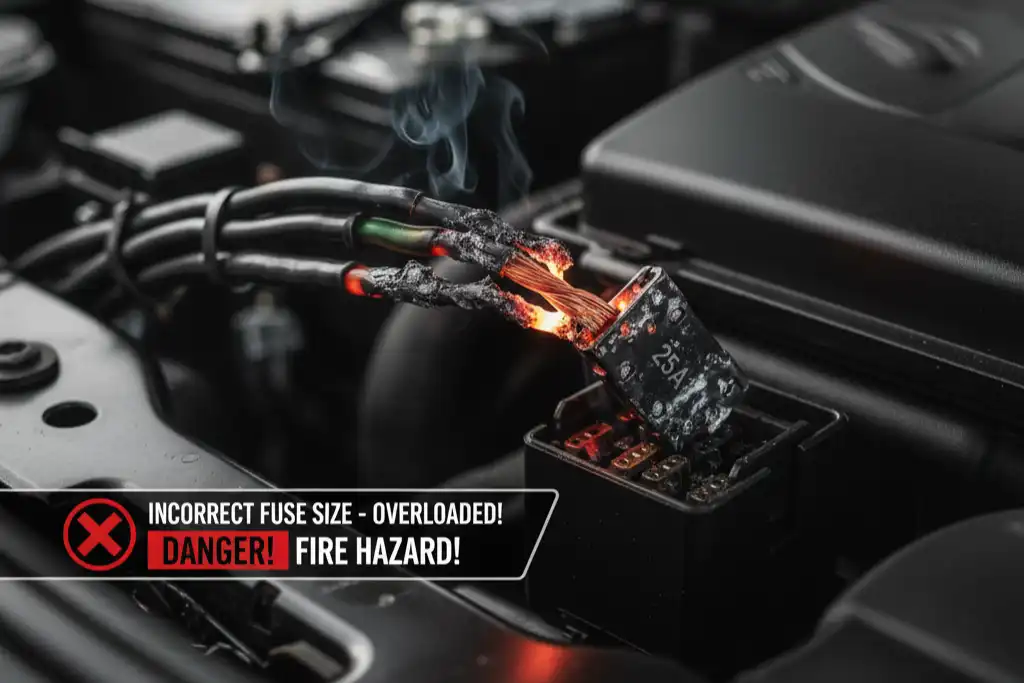
Some people think a bigger fuse is safer. This is not true. If the fuse is too big, too much current can flow. The fuse will not blow when it should. Your system loses its main safety feature.
Here is what happens if you use a fuse that is too large:
| Consequence | Explanation |
|---|---|
| Overheating | Too much current makes wires hot. The insulation can melt. |
| Fire Risk | Hot wires can ruin insulation and start a fire. Your equipment is in danger. |
| Device Failure | Devices can break if they get more current than they should. |
A fuse that is too big does not protect wires or devices. You could damage LED lights or burn out electronics. You might even start a fire. Always pick a fuse that matches your wire and device.
Tip: Never use a fuse bigger than your wire or device needs. Always check the specs before you choose.
Ignoring Wire Ampacity
You must always think about wire ampacity. Ampacity means the most current a wire can carry safely. If you ignore ampacity, wires can get too hot. They might melt or catch fire.
If you push too much current through a wire, it heats up. If it gets too hot, the insulation can break. This can cause shorts or make the circuit fail. It can even start a fire in your 12V system. Over time, the wire can get weak and stop working well.
To avoid these problems, always check the ampacity chart for your wire size. Make sure your fuse is never rated higher than the wire’s safe limit. If your device needs more current, use a thicker wire.
Note: Safe wiring starts with knowing your wire’s ampacity. Never go over the safe limit.
Bad Fuse Placement
Where you put your fuse is very important. If the fuse is far from the battery, part of the wire is not protected. This can be dangerous.
Here are some problems from bad fuse placement:
- Electronics can get damaged by inrush current.
- The fuse may not protect the circuit from overloads or shorts.
- Sensitive parts may get too much current before the fuse reacts.
Always put the fuse close to the power source. This helps the fuse work fast and protect the whole circuit.
Always follow the 7-inch rule. Put the fuse within 7 inches of the battery or power connection for best safety.
Skipping Steps
You might feel tempted to skip steps when sizing fuses for your 12V system. Maybe you want to save time or think you already know what you are doing. Skipping steps can lead to big problems. Each step in fuse sizing keeps your system safe and working well.
Many people skip these steps:
- Forgetting to check the actual current draw of the device.
- Ignoring the wire ampacity chart.
- Not applying the 125% or 250% safety margin.
- Rounding down to a non-standard fuse size.
- Skipping the wire length and temperature check.
- Not placing the fuse close to the power source.
When you skip any of these, you risk choosing the wrong fuse size. This can cause your fuse to blow too often or not blow when it should. Both problems can damage your equipment or even start a fire.
Always follow every step in the fuse sizing process. Each one protects your wires, devices, and even your safety.
Here is a table that shows what happens if you pick the wrong fuse size because you skipped steps:
| Fuse Size | Consequence |
|---|---|
| Too small | Frequent blowing, causing interruptions |
| Too large | Inadequate protection, risking equipment damage |
If you use a fuse that is too small, it will blow again and again. Your lights might go out, or your pump might stop working. This can get very annoying and may leave you without power when you need it most.
If you use a fuse that is too large, it may not blow when there is a problem. Your wires can overheat. Your devices can get damaged. In the worst case, you could start a fire.
You can avoid these problems by following a simple checklist:
- Measure or calculate the device current.
- Apply the correct safety margin (125% for most loads, 250% for motors).
- Check the wire ampacity for your wire size.
- Consider wire length and temperature.
- Choose the right fuse type and place it close to the power source.
Skipping even one step can put your whole system at risk. Take your time and check your work. You will keep your 12V system safe and reliable.
Remember, every step in fuse sizing matters. You protect your equipment, your wiring, and yourself when you follow the full process.
Safety Checklist
A safety checklist helps you avoid mistakes and keeps your 12V system reliable. You should always check your work before and after installing a fuse. This habit can prevent fires, equipment damage, and wasted time.
Pre-Installation Checks
Before you install any fuse, you need to make sure everything matches up. Start by looking at the main parts of your system. Check the charge controller, the wires, and the connectors. Each part must handle the current safely.
Here is a table to guide your pre-installation checks:
| Pre-installation Check | Description |
|---|---|
| Maximum Current Output of Charge Controller | Check the maximum output current listed in the charge controller’s specifications. |
| Safety Margin | Choose a fuse rated 10-20% higher than the maximum current output. |
| Wire and Connector Compatibility | Ensure the fuse size matches the wire gauge and connectors used in the system. |
You should always read the label or manual for your charge controller. Find the maximum current output. This number tells you how much current your system might use. Next, add a safety margin. Pick a fuse that is 10-20% higher than the maximum current. This helps the fuse handle small surges without blowing too soon.
Check your wires and connectors. Make sure the wire gauge matches the fuse size. If the wire is too thin, it can overheat. The connectors must also fit the wire and fuse. If you use the wrong size, you risk loose connections and heat buildup.
Tip: Double-check all connections before you install the fuse. A loose wire can cause big problems later.
Post-Installation Review
After you install the fuse, you need to review your work. This step helps you catch mistakes before they cause trouble. Use this checklist to guide your review:
- Inspect the fuse holder. Make sure it is secure and not loose.
- Check the fuse rating. The number on the fuse should match your calculation.
- Look at the wire insulation. It should not have any cuts or burns.
- Test the circuit. Turn on your device and watch for normal operation.
- Feel the wires and fuse holder after a few minutes. They should feel cool or only slightly warm.
If you notice any problems, turn off the power right away. Fix the issue before using the system again.
Remember: A quick review now can save you from big repairs later. Always take a few minutes to check your work.
A good safety checklist keeps your 12V system safe and reliable. You protect your equipment, your wiring, and yourself by following these steps every time.
Fuse Sizing: Cost vs. Risk
Real-World Consequences
Choosing the right fuse size does more than protect your wires. It can save you money and keep your equipment safe. When you use the wrong fuse, you risk more than just a blown fuse. You could face expensive repairs or even a fire.
Imagine you install a fuse that is too large for your wire. The fuse may not blow when a problem happens. The wire can overheat and melt. This can damage your car, RV, or boat. Sometimes, it can even start a fire. You may need to replace not just the wire, but also other parts that get damaged.
Here is what can happen if you do not size your fuse correctly:
- A fuse that blows often tells you there is a problem in the circuit.
- If you use a bigger fuse to stop it from blowing, you risk burning out your devices or melting wires.
- Fires and equipment failure can cost much more than a simple fuse replacement.
If you pick the right fuse, you protect your system from these dangers. You also avoid spending money on repairs that you could have prevented.
A fuse is designed to break the circuit when the current gets too high. This stops wires from overheating and keeps your system safe. When you select the correct fuse size, you lower the chance of equipment damage and costly repairs.
Prevention vs. Repair
You have a choice: prevent problems with the right fuse, or pay for repairs later. Prevention is always cheaper and safer.
Here are some ways proper fuse sizing helps you avoid big repair bills:
- The right fuse blows before wires or devices get damaged.
- You catch problems early, like a short circuit or a failing device.
- You avoid the risk of fire, which can destroy your whole system.
| Action | Result |
|---|---|
| Use correct fuse size | Prevents overheating and fire |
| Ignore fuse sizing | Increases risk of costly repairs |
| Upgrade wire if needed | Keeps system safe and reliable |
If you ignore fuse sizing, you may face these problems:
- Melted wires that need replacing
- Burned-out devices that stop working
- Fire damage that can ruin your vehicle or home
Prevention costs less than repair. A fuse only costs a few dollars, but fixing fire or equipment damage can cost hundreds or even thousands.
When you take the time to size your fuses correctly, you protect your investment. You keep your 12V system running safely and avoid the stress of emergency repairs. Always remember: the right fuse saves you money and keeps you safe.
You can keep your 12V system safe by following the right steps for 12V fuse sizing. Always match the fuse to both the device current and the wire ampacity. Review this checklist to avoid common mistakes:
- Never oversize the fuse.
- Place the fuse close to the power source.
- Check the cable size before choosing a fuse.
- Replace blown fuses with the same rating.
Stay alert and follow these steps for a reliable electrical system.
FAQ
What happens if I use a fuse that is too big?
A fuse that is too big will not blow when it should. Your wires can overheat and catch fire. You risk damaging your devices and your whole system.
How do I know what size fuse to use for my device?
Check your device’s wattage. Divide watts by 12 volts to get amps. Multiply by 1.25 for most devices. Round up to the next standard fuse size.
Can I use any wire size with any fuse?
No. You must match the fuse size to the wire’s ampacity. If the fuse allows more current than the wire can handle, the wire can overheat and melt.
Where should I place the fuse in my 12V system?
Place the fuse within 7 inches of the battery or power source. This protects the whole wire and keeps your system safe.
What is the difference between a glass tube fuse and a blade fuse?
A glass tube fuse is common in older electronics and small circuits. A blade fuse is used in cars and modern 12V systems. Blade fuses are easier to replace.
Do I need a special fuse for motors or pumps?
Yes. Motors and pumps draw more current when they start. Use the 250% rule: multiply running amps by 2.5, then round up to the next standard fuse size.
What should I do if my fuse keeps blowing?
Check for a short circuit or a device drawing too much current. Make sure you used the correct fuse size. Replace damaged wires or devices before installing a new fuse.
Can I use a circuit breaker instead of a fuse?
Yes, you can use a circuit breaker. It protects your system like a fuse but can be reset instead of replaced. Always match the breaker rating to your wire and device.
See also
How to calculate the wire size for circuit breakers with different currents
What Is a Fused Distribution Box and How Does It Work
What size of wire is needed for a 30 ampere circuit breaker
How to connect solar panels to 12 volt batteries and inverters
What trip circuit breakers and blown fuses indicate