You should know the big differences between AC vs DC combiner boxes in solar installations. Understanding these differences helps keep your system safe and compliant with regulations. Choose a box that matches the number of panels you have and their voltage. Implement good grounding and waterproof cable glands to prevent voltage spikes and water ingress. Always use the correct fuse size to avoid tripping or breaking, and select durable components to ensure your system lasts a long time. Position your combiner box near the solar panels and in a shaded area. This reduces voltage drop and prevents the box from overheating.
- Use the right fuse size so it does not trip or break.
- Make sure grounding is strong for safety.
- Close any unused holes to block water.
- Put the box close to the panels for better performance.
- Use shade to keep components safe.
- Choose reliable breakers and surge protectors.
Key Takeaways
- Know how AC and DC combiner boxes are different. DC boxes take power from solar panels. AC boxes mix power from inverters.
- Pick the right combiner box for your system’s voltage and current. This stops damage and keeps people safe.
- Put your combiner box near the solar panels. Place it in a shaded spot. This lowers voltage drop and stops it from getting too hot.
- Use good grounding and waterproof cable glands. This keeps your system safe from voltage spikes and water.
- Choose strong parts like good breakers and surge protectors. This helps your solar system last longer and stay safe.
- Check your combiner box often for loose wires, rust, and dust. This keeps your system working well and safe.
- Follow local rules and standards when you install combiner boxes. This helps you pass checks and follow the law.
- Keep learning about new safety rules. Knowing more helps you make smart choices for your solar projects.
AC vs DC Combiner Boxes in Solar Installations
Roles in Solar Systems
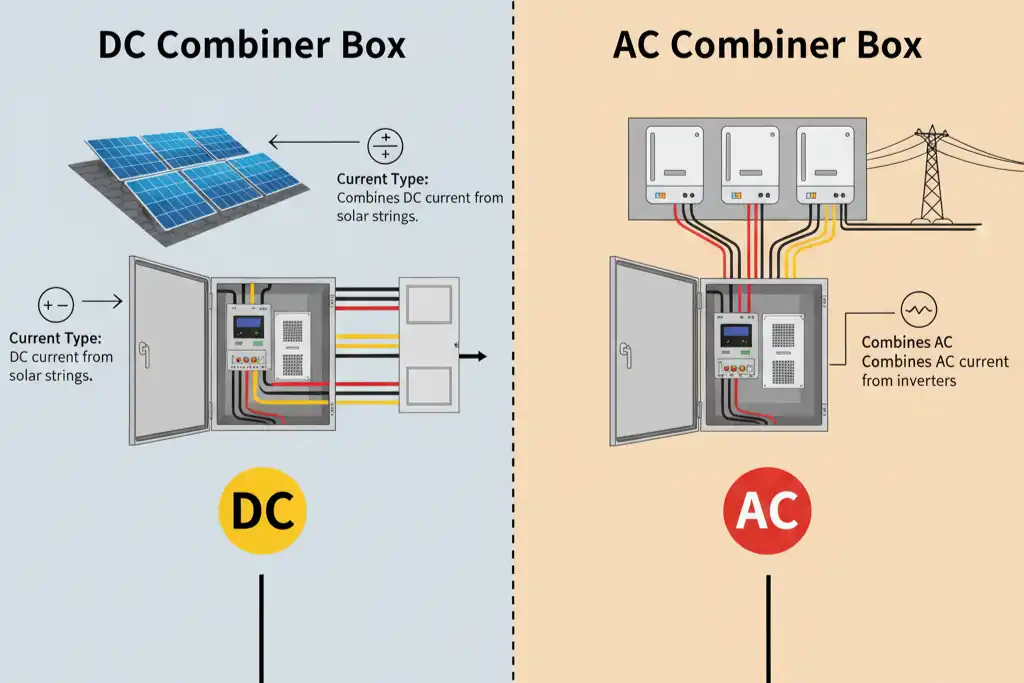
It is important to know what AC and DC combiner boxes do. DC combiner boxes take direct current from solar panels and send it to the inverter. AC combiner boxes work with alternating current from inverters and send it to the grid. Both types help your solar system work better, but they have different jobs.
Here is a table that shows the differences:
| Type of Combiner Box | Current Type | Functionality |
|---|---|---|
| DC Combiner Box | Direct Current (DC) | Collects DC power from solar panels and sends it to the inverter. This makes wiring easier in big systems. |
| AC Combiner Box | Alternating Current (AC) | Combines power from inverters before sending it to the grid or building. This helps share energy. |
When you look at AC and DC combiner boxes, you see DC combiner boxes work with energy straight from the sun. AC combiner boxes handle power after the inverter changes it.
System Position: Before and After Inverter
DC combiner boxes go before the inverter. They collect DC electricity from many solar panels and send it to the inverter. This keeps the wiring simple and safe.
AC combiner boxes go after the inverter. They combine AC power from one or more inverters. You use them to connect the solar system to the main panel or the grid. This helps you control energy flow and makes the system easier to manage.
- DC combiner boxes work on the DC side and handle raw solar energy.
- AC combiner boxes work on the AC side and connect to the building or grid.
When you compare AC and DC combiner boxes, you see their place in the system matches their job. DC combiner boxes are needed for the DC side, and AC combiner boxes are needed for the AC side.
Importance of Correct Ratings
You need to pick combiner boxes with the right ratings for your system. If you use the wrong rating, your equipment can get damaged and become unsafe. Wrong ratings can cause problems like insulation breaking down, lower performance, or even fire.
Here is a table that shows what can happen if you use the wrong ratings:
| Hazard Type | Consequence |
|---|---|
| Accelerated Aging | Shorter life for parts inside the box, like cable insulation and fuse contacts. |
| Performance Degradation | The system does not work as well. |
| Insulation Breakdown | Higher chance of electrical problems. |
| Spontaneous Combustion | There could be a fire. |
You should always check the voltage and current ratings for each combiner box. If the current is too low, the breaker might not trip when it should. If the voltage is too high, there could be dangerous sparks. The space inside the breaker might not stop the spark, which can be risky.
When you compare AC and DC combiner boxes, you see that using the right ratings keeps your system safe and working well. Always match the box to your system’s needs to avoid problems and keep everyone safe.
Tip: Always read the manufacturer’s instructions and follow local rules when picking combiner boxes. This helps you avoid problems and keeps your solar system working right.
Components and Safety Features
DC Combiner Box Essentials
DC combiner boxes have many parts that help keep your solar system safe. These boxes take power from solar panels and send it to the inverter. Inside a DC combiner box, you will see some important parts.
- PV String fuses stop electricity if something is wrong. They keep your system safe from too much current.
- DC surge protection devices (SPD) send extra power into the ground. They protect your system from sudden voltage spikes.
- DC disconnect switch or DC circuit breaker lets you cut power during problems. This keeps your system safe.
- Busbar joins negative or ground wires from the solar panels.
- Terminal Strip works like a busbar but is made from ABS composite.
- Enclosure is the box that holds all the parts. It keeps out dust, wind, and water.
Fuses and Disconnects
Fuses and disconnect switches are very important for safety. Fuses break the circuit if the current is too high. Disconnect switches let you turn off the power for repairs. Always check that these parts match your system’s voltage and current.
Surge and Arc Fault Protection
DC combiner boxes have special safety features. Surge protection devices (SPDs) help protect your system from lightning and voltage spikes. Arc Fault Circuit Interruption (AFCI) finds dangerous sparks that can cause fires. Rapid Shutdown (RSD) lets you turn off the system fast in emergencies. These features protect your equipment and people working nearby.
Note: DC isolator switches help you disconnect solar panels during repairs. This keeps workers safe from direct current.
Here is a table with some key safety features:
| Safety Feature | Description |
|---|---|
| Arc Fault Circuit Interruption (AFCI) | Finds dangerous sparks that can start fires. |
| Rapid Shutdown (RSD) | Lets you quickly disconnect the system in emergencies. |
| Surge Protection Devices (SPDs) | Sends harmful energy from lightning safely to the ground. |
AC Combiner Box Essentials
AC combiner boxes work with power after the inverter. You use them to combine AC power before sending it to the grid or building. These boxes have their own important parts.
- Circuit breakers stop electricity if the current is too high. They protect your system from overcurrent.
- Current transformers (CTs) measure how much current is in the wires.
- Surge Protection Devices (SPDs) protect your system from power surges and lightning.
Circuit Breakers and CTs
Circuit breakers are the main safety parts in AC combiner boxes. They trip when the current is too high. Current transformers help you watch the system and track energy use.
Overcurrent and Ground Fault Protection
AC combiner boxes also protect against overcurrent and ground faults. Overcurrent protection stops electricity if the current is too high. Ground fault protection keeps your system safe if electricity goes where it should not. Surge protection devices give extra safety.
When you look at AC and DC combiner boxes, you see both have strong safety features. Each box uses different parts to protect your system and keep people safe.
Standards and Certifications

UL, NEC, IEEE, IEC Overview
You need to know the main standards that apply to combiner boxes in solar installations. These standards help you make sure your system is safe and works well. Each standard covers a different part of the system. When you follow these rules, you protect people and equipment.
Here is a table that shows the key standards for combiner boxes:
| Standard | Description |
|---|---|
| UL 1741 | Required for grid-connected PV equipment |
| NEC compliance | Must meet current National Electrical Code requirements (2023 edition) |
| IEEE 1547 | For grid interconnection standards |
| IEC 61439 | For low-voltage switchgear and controlgear assemblies |
UL 1741 tells you what safety features your combiner box must have if you connect it to the grid. The National Electrical Code (NEC) gives you rules for wiring, grounding, and protection. You must follow the latest NEC edition, which is now the 2023 version. IEEE 1547 sets the rules for how your solar system connects to the grid. IEC 61439 covers the design and testing of low-voltage assemblies, like combiner boxes.
Tip: Always check the label on your combiner box. Look for marks that show it meets these standards. This helps you pass inspections and keeps your system safe.
Inspection and Compliance
You must make sure your installation passes inspection. Inspectors look for proof that your combiner boxes meet all the right standards. They check the labels, wiring, and safety features. If you miss a requirement, you may need to redo your work.
To help you stay compliant, follow these steps:
- Read the Manufacturer’s Documentation
The manual tells you if the box meets UL, NEC, IEEE, and IEC standards. - Check for Certification Labels
Look for UL or IEC marks on the box. These marks show the box passed safety tests. - Follow Local Codes
Some areas have extra rules. Always check with your local authority. - Keep Records
Save all documents and test results. You may need to show them during inspection. - Test Before Final Connection
Use a checklist to make sure you did not miss anything.
Note: Passing inspection is not just about following rules. It also keeps your system safe and reliable for years.
When you follow these steps, you avoid costly rework and delays. You also build trust with your customers and local inspectors. Meeting standards and passing inspections show you care about quality and safety in every solar project.
Selection Framework
Picking the right combiner box keeps your solar system safe. You need to follow steps to avoid mistakes. This makes sure your setup meets all rules.
Map System Architecture
First, you should map out your system. You need to know where power comes together in your solar setup. Here are some steps:
- Find the places where you combine power.
- Draw how power moves from panels to the grid. Mark every spot where wires join.
- If you use string inverters, combine DC outputs before the inverter with a DC combiner box.
- If you use microinverters, combine AC outputs before the main panel with an AC combiner box.
- For hybrid systems, trace the power flow. Decide if you need both AC and DC combiner boxes.
Tip: Mapping your system shows where each combiner box goes. This helps you avoid mistakes and keeps your wiring neat.
Match Ratings and Components
After mapping, match the ratings and parts of your combiner box to your project. Look at your system voltage, array layout, and protection needs. Use this table to help you choose:
| Customization Option | Why It Matters for Your Project |
|---|---|
| Strings & Fuse Count | Make sure your array design fits, from 2 to over 32 strings. |
| Enclosure Material & Size | Pick metal or plastic for protection and get the right size. |
| Cable Gland Placement | Choose top, bottom, or side entries for easy wiring. |
| SPD or Disconnect Brand | Use the parts your project or client wants. |
| Smart Monitoring | Add monitoring to watch performance and find problems early. |
| Private Labeling (OEM) | Put your brand on the box for a professional look. |
Check technical details like voltage and layout. Use the right fuses and surge protectors. These steps help your combiner box work well and keep your system safe.
Note: Matching ratings and parts stops damage and keeps your system working.
Verify Safety and Certifications
You must check that your combiner box has all safety certifications. This keeps your system safe and helps you pass inspections. Try these methods:
- Insulation resistance testing finds problems and stops electrical faults.
- This testing makes sure your system follows safety rules.
- You can check if your solar module strings meet insulation resistance levels.
Look for standards like UL1741. This standard checks safety and performance for solar equipment. See the table below for more info:
| Certification Standard | Description |
|---|---|
| UL1741 | Checks safety and performance of solar equipment for reliability. |
Tip: Always look for safety labels on your combiner box. These labels show your box passed safety tests.
If you follow these steps, your combiner box will fit your system and meet safety rules. You lower the chance of problems and build trust with customers. Comparing AC and DC combiner boxes is easier when you use this framework.
Real-World Scenarios

Commercial Rooftop: DC Combiner Box
DC combiner boxes are common on big business rooftops. Large companies use these boxes to gather power from many solar panels. The box helps control the power before it goes to the inverter. This makes energy collection better and keeps the system easy to fix. In some places, like factories in Germany, smart combiner boxes are used. These boxes watch energy output and help follow environmental laws.
- Big solar arrays at businesses use DC combiner boxes for better control.
- Factories use smart boxes to track energy and follow rules.
If you put solar panels on a business, pick a DC combiner box that fits the number of strings and voltage. You should also check for surge protection and strong cases. This keeps the system safe and working well.
Residential Microinverters: AC Combiner Box
Homes with microinverter systems use AC combiner boxes. These boxes help manage many microinverter circuits. You can connect all wires in one spot, which makes setup easy. You do not have to change the main load center. Each circuit breaker gets its own overcurrent protection in the box. This makes the system safer and easier to fix.
- AC combiner boxes keep microinverter circuits neat and organized.
- You can put the box outside, which is handy.
- The box lets you connect and talk to everything at once.
- Each circuit has its own breaker, so the system is more reliable.
If you work on a home solar project, pick an AC combiner box that matches the number of microinverters. Look for boxes with weatherproof cases and clear labels.
Hybrid Systems: Both Boxes
Hybrid solar systems need both AC and DC combiner boxes. The DC combiner box gathers power from the panels and sends it to the inverter. After the inverter changes DC to AC, the AC combiner box combines power from several inverters. This setup helps you control energy flow and connect to the grid or send power inside a building.
| Type of Combiner Box | Function | Application |
|---|---|---|
| DC Combiner Box | Combines outputs from solar panels or strings | Connects to inverter for DC to AC conversion |
| AC Combiner Box | Aggregates outputs of multiple inverters | Feeds into grid or distributes in facility |
- You need both boxes to control and change energy well.
- DC combiner boxes help organize panel outputs.
- AC combiner boxes help control inverter outputs and connect to the grid.
When you design a hybrid system, plan where each box will go. Check ratings and certifications for both boxes. This makes sure your system works right and is safe.
Tip: Always plan your system before picking combiner boxes. This helps you avoid wiring mistakes and keeps your setup safe.
Risks of Incorrect Selection
Safety Hazards
Picking the wrong combiner box can make your solar system unsafe. If the box does not match the voltage or current, problems can happen. Loose wires might break the insulation. This can make the box get too hot and start a fire. If circuit breakers are too small or broken, they may not stop dangerous currents. Water and dust can get inside if the box is not sealed well. This can cause rust or short circuits. You need to keep your system safe from these dangers.
⚠️ Always make sure grounding is strong and wires are tight. Good setup helps keep your system safe.
Some common safety problems include:
- Getting too hot from weather.
- Fire risk from bad insulation.
- Breakers not working because of wrong size.
- Water getting in and causing rust.
- Dust building up and causing shorts.
Ignoring these dangers can hurt people and damage property. You must be careful when picking and installing combiner boxes.
Failed Inspections
Choosing the wrong box can make you fail inspection. Inspectors want to see neat work and safe wiring. They check if the solar PV system is grounded right. If wires are the wrong size or put in wrong, you might not pass local rules like the California Electrical Code. Bad grounding that does not match the plans also causes trouble.
Reasons for failed inspections include:
- Messy wires or bad layout.
- Loose wires that do not meet rules.
- Wrong wire size or type.
- Grounding that does not match the plans.
If you do not pass inspection, you must fix the problems before using your system. This can slow down your project and cost more money.
📝 Tip: Always follow the plans and local rules. Check your work before inspection.
Costly Rework
Picking the wrong combiner box can waste time and money. If the box is wrong, you may need to buy a new one. You might have to redo wires or change breakers. Water or dust damage can make you fix or replace parts. If you fail inspection, you must fix mistakes and get checked again.
Here is a table that shows how mistakes can cost you:
| Mistake | Result | Cost Impact |
|---|---|---|
| Wrong box rating | Equipment damage | High |
| Poor installation | Loose connections | Medium |
| Inadequate protection | Fire or short circuit | Very High |
| Failed inspection | Project delays | Medium to High |
You save money and avoid problems by picking the right box first. Careful planning and checking details help you stop expensive mistakes.
✅ Picking the right box and installing it well protects your money and keeps your solar system working.
Best Practices for Installers
Trace Power Flow
It is important to know how electricity moves in your solar system. Tracing power flow helps you find problems and keep things working. Here are some steps to help you trace power flow:
- Put Safety First
Learn how your PV system is set up. Make sure all equipment matches the voltage and current you need. - Check Weather Conditions
Test your system when the sun is bright. Try to work between 10:00 AM and 3:00 PM, when sunlight is strong. - Set Up Your Tools
Use an I-V curve tracer for testing. Put in sensors and use a lockout/tagout kit to keep the combiner box safe. Check that all wires are tight. - Run the I-V Curve Test
Connect the tracer and close a fuse holder. Do the test and save your results. - Analyze the Results
Look at your test results and compare them to what you expect. If you see something different, there may be a problem.
Watching your combiner box helps you find weak panels and faults. This helps your system work better and last longer.
You should also:
- Look for damage or wear often.
- Make sure all wires are tight and not rusty.
- Test fuses and breakers to see if they work.
- Keep the combiner box clean and free of dust.
Prioritize Safety
Safety is always the most important thing when working with combiner boxes. Use these tips to keep yourself and your system safe:
| Best Practice | Description |
|---|---|
| Systematic Maintenance Protocols | Use the same steps each time you do maintenance. This keeps your system working well. |
| Regular Inspections | Look at your system every few months and do a full check each year. This helps you find problems early. |
| Quality Sourcing of Materials | Pick strong, well-made combiner boxes to stop failures. |
| Proper Documentation | Write down all details for warranties and fixing problems. |
| Factory Assembly Advantages | Use boxes that are wired and tightened at the factory to avoid mistakes. |
| Ground Faults and Arc Faults Protection | Put in safety devices like GFDIs and AFCIs to stop dangerous electrical problems. |
🛡️ Always use the right tools and follow safety rules. Good habits keep you and your team safe.
Consult Experts
Every solar project is different. Sometimes you need help to get the best results. You should talk to electrical engineering experts when:
- Your project needs a special solution.
- The size, place, or goals of your project are different.
- You want a solution that fits your needs.
Experts help you design a safe and good system. They give advice on the right combiner box and help you avoid mistakes. They also help you follow all codes and standards.
Tip: If you are not sure about any part of your system, ask an expert. This keeps your project safe and on track.
When you choose an AC or DC combiner box, follow these steps:
- Check that the box matches your system and inverter.
- Look for safety features like fuses and surge protectors.
- Pick a weatherproof box for outdoor use.
- Think about smart features for easy monitoring.
- Plan for future growth with extra capacity.
| Benefit of Ongoing Learning | Why It Matters |
|---|---|
| NEC Updates | You stay current with safety rules. |
| Integral Disconnects | You protect yourself during maintenance. |
| Arc Fault Protection | You keep your system safe from fire. |
Keep learning and ask experts when you need help. This keeps your solar projects safe and up to date.
FAQ
What is the main difference between AC and DC combiner boxes?
You use DC combiner boxes before the inverter to collect solar panel power. You use AC combiner boxes after the inverter to combine power for the grid or building.
How do I know which combiner box my system needs?
Check your system design. If you use string inverters, you need a DC combiner box. If you use microinverters, you need an AC combiner box.
Why do combiner boxes need surge protection?
Surge protection keeps your system safe from lightning and voltage spikes. It helps prevent damage to your equipment and reduces fire risk.
Can I install a combiner box outdoors?
Yes, you can install combiner boxes outdoors. Pick a weatherproof box with a strong enclosure. Make sure it has good seals to keep out water and dust.
What certifications should I look for on a combiner box?
Look for UL1741, NEC, and IEC marks. These show the box meets safety standards. Certification helps you pass inspections and keeps your system safe.
How often should I inspect my combiner box?
You should inspect your combiner box every few months. Check for loose wires, rust, and dust. Test fuses and breakers to make sure they work.
What happens if I use the wrong combiner box?
Using the wrong box can cause safety hazards, failed inspections, and costly repairs. You risk fire, equipment damage, and project delays.
Do combiner boxes need regular maintenance?
Yes, regular maintenance keeps your system safe and working well. Clean the box, check connections, and test safety devices often.
See also
Combiner box solutions for your AC and DC needs
How to Wire Multiple Solar Panels into a Combiner Box Safely
Why Your Solar Energy Setup Requires a Combiner Box
Fire safety guidelines for solar combiner boxes
Solar Combiner Boxes and Voltage Changes: What to Know